Imagine running a manufacturing production line without knowing the true cost of a breakdown. A machine fails, production stops, teams react, and the issue is resolved, but the financial impact remains unclear. This is the reality for many industrial organizations operating without a clear view of their maintenance performance.
Predictive Maintenance (PdM) changes this dynamic by using condition monitoring data and asset health insights to anticipate failures, reduce unplanned downtime, and improve maintenance decision-making. However, adopting PdM is not just a technical decision. Organizations must also understand whether the Predictive Maintenance benefits justify the total investment required to deploy and operate the program.
At its core, Predictive Maintenance ROI answers a simple question: how quickly and effectively can a Predictive Maintenance program generate financial gains (reduced downtime, lower maintenance costs, improved productivity, and avoided failures) that outweigh the total investment required to deploy and operate the solution?
Understanding this balance enables organizations to build a credible business case, justify investments, secure stakeholder alignment, and scale data-driven maintenance strategies.
In this article, you will find a step-by-step approach to calculating Predictive Maintenance return on investment, explore a concrete ROI example, understand the main value drivers, and identify the key levers to maximize financial performance.
Table of Contents
What is ROI in Predictive Maintenance?
Return on Investment (ROI) in Predictive Maintenance (PdM) is a financial metric used to determine whether a PdM program generates more value than it costs. It compares the total investment required to deploy and operate the solution (cash-out) with the financial benefits it generates over time (cash-in):
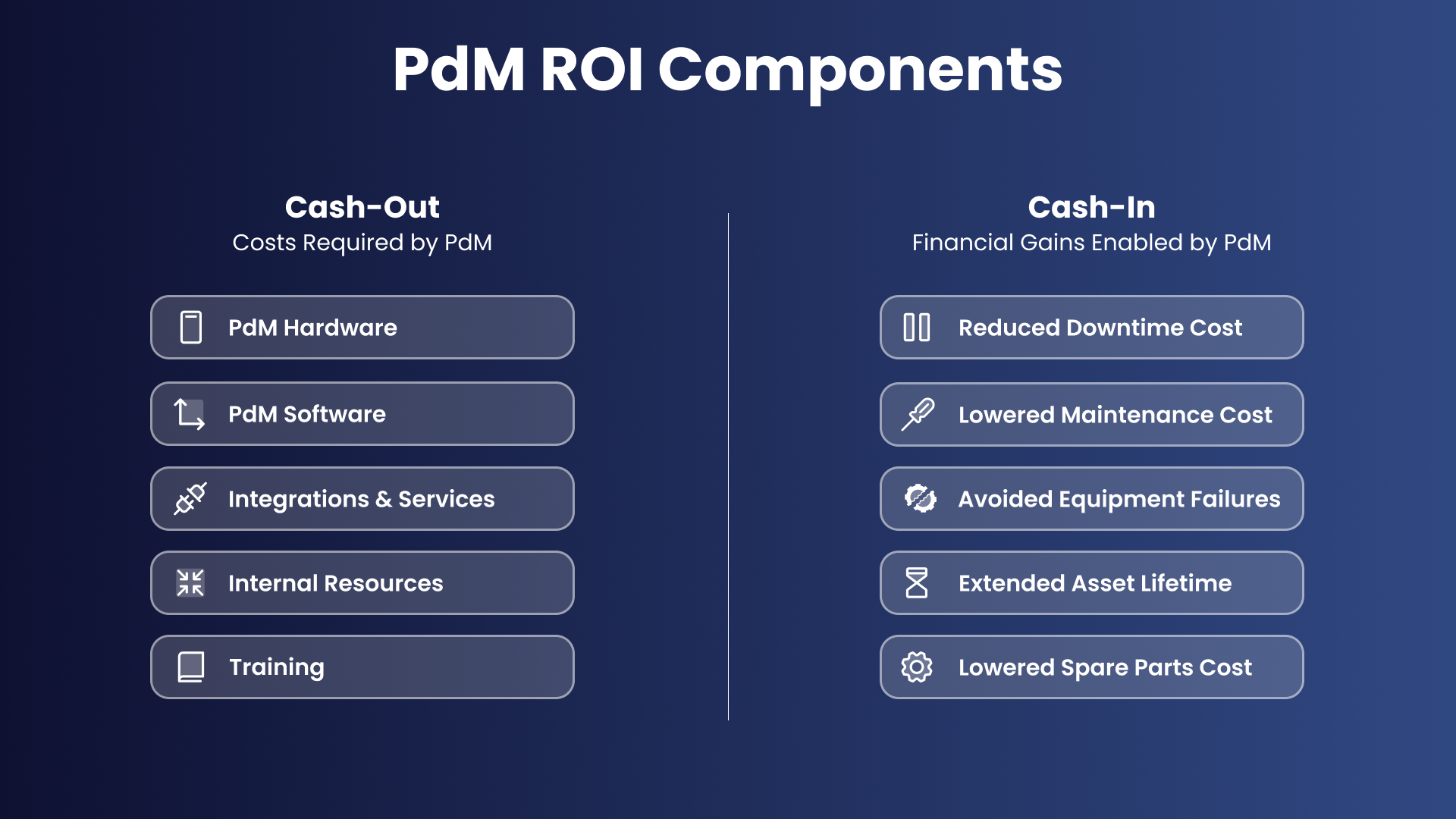
- Cash-out includes all costs required to deploy and operate the PdM program, such as wireless sensors, PdM software, integration and other outsourced services, and internal resources, including training.
- Cash-in represents the measurable financial gains enabled by PdM, such as reduced downtime costs, lower maintenance expenses, avoided failures, and other forms of cost avoidance.
At its core, PdM ROI assesses whether the financial gains from improved maintenance decisions exceed the total cost of the solution.
In industrial environments, where financial performance drives investment decisions, return on investment translates the measurable impact of maintenance actions, informed by asset health data and predictive analytics, into a clear economic indicator, helping express their value in business terms and supporting decision-making.
Why ROI Matters in Predictive Maintenance?
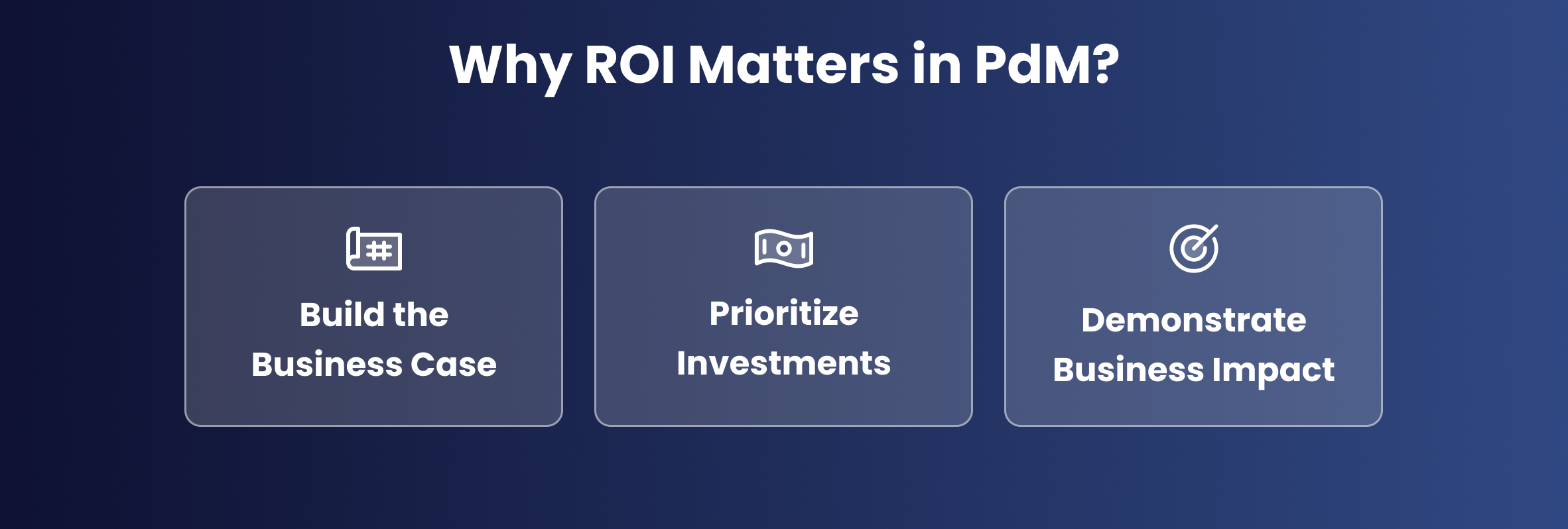
Predictive Maintenance (PdM) is often recognized for its technical capabilities, but its adoption ultimately depends on its ability to deliver measurable business value. Return on investment helps make that value visible and credible, supporting more informed and actionable decision-making.
In practice, many PdM initiatives struggle to move beyond the pilot phase. Even when early results are promising, the absence of quantified impact makes it difficult to secure budget, align stakeholders, and justify scaling across the organization. ROI addresses this gap by translating measurable operational benefits into quantified financial outcomes, helping build the business case required to move from experimentation to full deployment.
It also plays a key role in prioritization. Not all assets generate the same level of impact, and organizations rarely deploy Predictive Maintenance across all equipment simultaneously. By quantifying the financial consequences of failures, return on investment helps identify where investments should be prioritized first and where Predictive Maintenance is most likely to generate the highest return.
Finally, ROI links maintenance performance to business results by quantifying the financial impact of technical indicators such as reduced failures or improved asset condition, helping position maintenance as a contributor to overall company performance.
This is where the benefits of Predictive Maintenance become tangible from a business perspective, as improvements in asset reliability, downtime reduction, and maintenance efficiency are translated into measurable financial outcomes.
This distinction becomes especially important when evaluating the return on investment of predictive maintenance software, which represents only one component of a broader PdM program and whose value depends on how effectively it is integrated into maintenance workflows and decision-making processes.
How to Calculate ROI in Predictive Maintenance?
Moving from a reactive maintenance approach to a Predictive Maintenance strategy requires more than technical improvements. It also requires clear ROI calculations based on consistent assumptions and reliable data to ensure that financial justification is credible.
Calculating return on investment in Predictive Maintenance (PdM) is the process that translates operational gains into a format that decision-makers can evaluate.
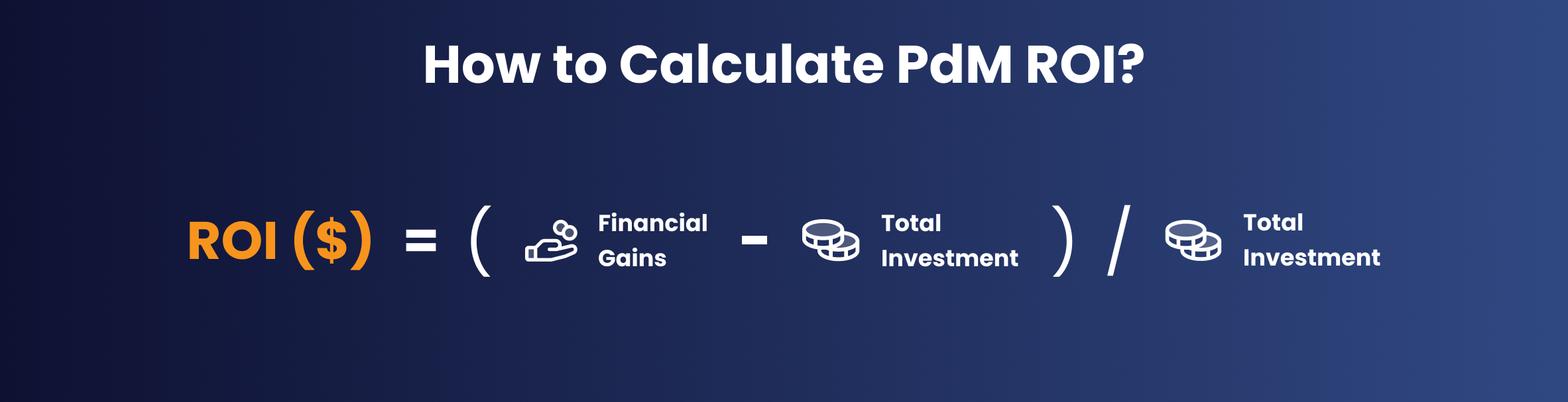
The standard formula is:
ROI = (Financial gains – Total investment) / Total investment
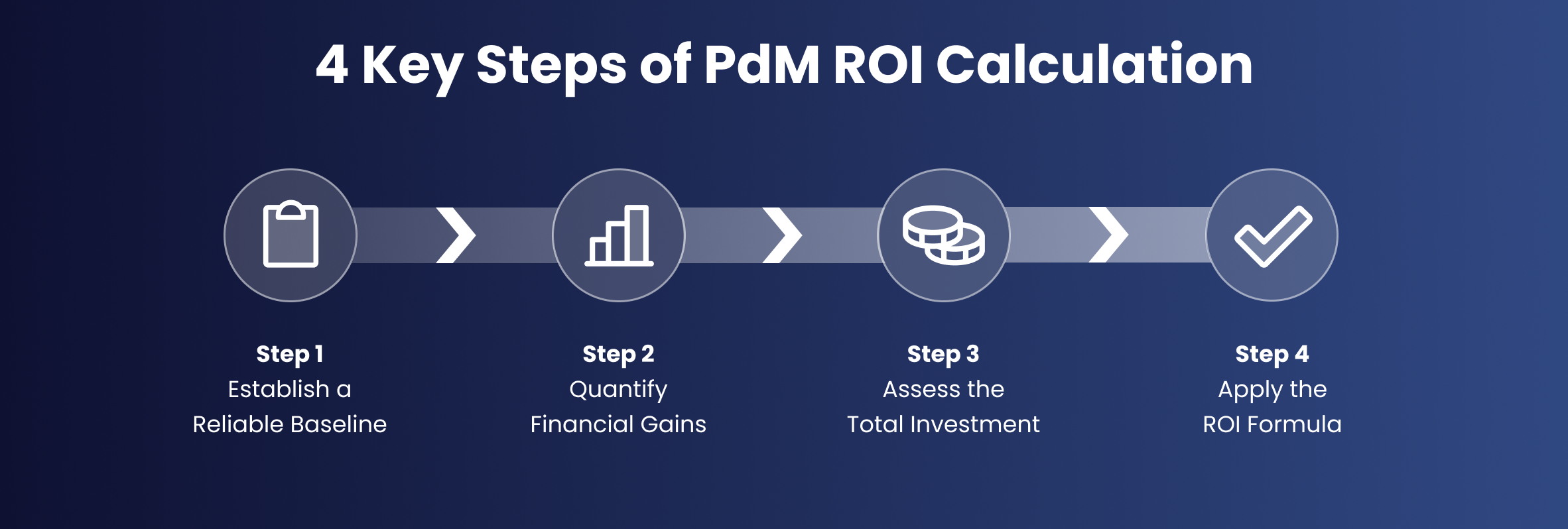
To apply this formula effectively, the calculation typically follows four key steps:
- Step 1: Establish a reliable baseline. Start by collecting historical data on current operational performance and asset condition, including unplanned downtime, maintenance costs, production losses, and energy consumption. This baseline is essential to measure the real impact of PdM.
- Step 2: Quantify the financial gains. In many industrial environments, avoided downtime is a primary contributor and can be estimated by multiplying the duration of avoided outages by the cost of lost production per hour. Additional gains may include reduced maintenance costs, optimized spare parts inventory and reduced emergency procurement, fewer emergency interventions, improved labor and operational efficiency, energy savings, and deferred capital expenditures.
- Step 3: Assess the total investment. Identify all costs associated with the PdM program, including monitoring equipment, software, implementation, integration, and internal resources such as training and data analysis.
- Step 4: Apply the ROI formula. Once gains and costs are quantified, apply the ROI formula to determine whether the financial value generated exceeds the investment and to support decisions on scaling or adjusting the program.
Common Mistakes When Calculating PdM ROI
Calculating return on investment in Predictive Maintenance (PdM) is often less straightforward than it seems. In practice, many calculations are distorted by incorrect assumptions, inconsistent methodologies, or incomplete operational data, leading to misleading conclusions and unrealistic expectations.
The most common mistakes include:
- No reliable baseline: Skipping the baseline can significantly weaken ROI calculations. Without a reasonably clear starting point (downtime, maintenance costs, production losses), it becomes much more difficult to accurately measure the impact of the PdM program and demonstrate the full value generated over time. However, many organizations progressively refine their baseline as the PdM program matures and greater operational visibility becomes available over time.
- Overestimating financial gains: Avoid the trap of overestimating difficult-to-quantify benefits such as employee comfort or general satisfaction. ROI must be based on measurable financial gains, such as reduced downtime, lower maintenance costs, or energy savings.
- Underestimating total costs: Focusing only on hardware or software often overlooks important operational factors such as integration, data analysis, training, workflow adaptation, and internal or external expertise, leading to incomplete ROI calculations.
- Ignoring execution after detection: A prediction only creates value if it leads to action. Without clear maintenance workflows, prioritization processes, and effective coordination between monitoring and maintenance teams, the expected financial gains may never materialize.
- Inconsistent calculation methods: Mixing different timeframes, assumptions, KPIs, or calculation approaches makes ROI difficult to interpret and weakens its credibility for operational and strategic decision-making.
How Can You Avoid Common Mistakes When Building a PdM ROI Strategy?
Building a credible Predictive Maintenance ROI strategy requires more than isolated calculations, disconnected tools, or standalone technology deployment. It depends on structured methodologies, reliable monitoring processes, operational integration, and the ability to translate technical insights into measurable financial outcomes.
At I-care, we help organizations avoid the most common ROI implementation pitfalls by combining connected technologies, reliability expertise, and operational support to build scalable, data-driven, and financially credible Predictive Maintenance programs.
Example of Predictive Maintenance ROI
To understand how return on investment in Predictive Maintenance (PdM) is evaluated in practice, it is useful to translate the methodology into a simplified but realistic industrial scenario.
Consider a medium-to-large industrial production site operating multiple rotating assets where unplanned downtime represents a significant operational and financial risk.
In this example, the PdM program covers approximately 75 assets monitored through around 300 wireless sensors connected to an analytics platform. The monitored equipment includes pumps, motors, conveyors, and other production-critical machinery where early detection of abnormal behavior can help reduce production interruptions, improve maintenance planning, and avoid high-impact failures.
Before implementing PdM, the site experienced recurring equipment issues leading to unplanned downtime, emergency maintenance interventions, secondary damage, and production losses. In this context, even a limited reduction in unexpected failures can generate substantial operational and financial value.
The following example illustrates how operational savings, cost avoidance, and long-term reliability improvements can contribute to measurable financial gains after implementing a PdM program combining wireless vibration sensors, PdM software, condition monitoring, and reliability analysis services.
First-Year Predictive Maintenance ROI
To quantify this impact, the following example illustrates how a combination of operational savings, maintenance optimization, and avoided production losses can contribute to measurable financial gains during the first year of a PdM program.
In many industrial environments, the financial value generated by Predictive Maintenance is not limited to direct maintenance savings. A significant portion of return on investment often comes from avoided losses associated with major failures, production interruptions, emergency interventions, and secondary damage. The following example reflects this broader loss-avoidance perspective.
ROI calculation:
ROI = (Financial gains – Total investment) / Total investment
The figures below are simplified illustrative estimates based on commonly observed industrial maintenance and production scenarios. Actual financial impact varies depending on asset criticality, production value, maintenance maturity, failure severity, and operational conditions.
| Scenario | Without PdM | With PdM |
| Equipment condition | Failure develops undetected | Early anomaly detected |
| Maintenance approach | Emergency intervention | Planned intervention |
| Production impact | Unplanned production interruption | Planned production downtime with controlled operational impact |
| Estimated maintenance and repair cost | ~$65,000 | ~$50,000 |
| Operational consequences | Secondary damage, emergency response, production losses, and immobilization | Controlled maintenance execution with limited operational disruption |
| Estimated operational losses related to one major prevented failure | ~$130,000 – $200,000 | / |
| Estimated initial PdM deployment investment (75 assets / 300 sensors) | / | ~$160,000 – $250,000 |
Using the simplified figures above, a single prevented failure generating approximately $130,000 – $200,000 in avoided losses could offset a substantial portion of the estimated initial PdM program investment of $160,000 – $250,000.
While the financial impact of any individual event varies depending on operational context, the example illustrates how avoided losses and maintenance optimization can contribute to Predictive Maintenance ROI.
Note: In practice, Predictive Maintenance programs continuously monitor multiple critical assets simultaneously. As additional anomalies are detected and addressed over time, cumulative avoided losses and reliability gains progressively increase across the monitored asset base.
Total Cost of Ownership (TCO) Over 3 and 5 Years
In practice, Predictive Maintenance ROI is not evaluated solely through isolated failure-prevention events or first-year financial impact.
Because PdM programs combine an initial deployment investment with recurring monitoring, software, analysis, support, and operational integration costs, organizations typically assess ROI through a broader Total Cost of Ownership (TCO) perspective over multiple years.
For a deployment covering approximately 75 monitored assets and around 300 wireless sensors, the cumulative Total Cost of Ownership (TCO), including the initial deployment investment and recurring operational costs, may typically reach:
- Approximately $280,000 – $370,000 over 3 years
- Approximately $400,000 – $490,000 over 5 years
depending on the selected monitoring model, analytical support level, deployment scope, operational complexity, and reliability engineering services involved.
While these recurring costs extend throughout the program lifecycle, the financial gains generated through avoided failures, reduced downtime, maintenance optimization, and improved reliability also accumulate progressively over time. As a result, organizations typically evaluate Predictive Maintenance performance over multiple years rather than through isolated events or short-term cost comparisons.
As additional anomalies are detected earlier, maintenance workflows become more proactive, and reliability strategies mature, cumulative avoided losses and reliability gains can increasingly offset the long-term operational cost of the program across the monitored asset base.
Looking for a More Flexible Way to Deploy Predictive Maintenance?
Not every organization wants to make a significant upfront investment (CapEx) to start benefiting from Predictive Maintenance. For companies looking to accelerate deployment while limiting initial costs, subscription-based approaches offer an alternative path.
With Predictive Maintenance as a Service, I-care provides wireless sensors, software, connectivity, and expert support through a monthly subscription. I-care’s Subscription model enables organizations to deploy PdM faster and reduce initial financial commitment.
What Does Predictive Maintenance Cost?
To calculate ROI accurately, it is essential to understand the full scope of investment required to deploy and operate a Predictive Maintenance (PdM) program.
In practice, costs go beyond hardware alone and typically include several components:
- Monitoring equipment: Sensors (e.g., Wi-care sensors) and data acquisition systems used to collect asset condition data (e.g., vibration monitoring, oil analysis, infrared thermography, or ultrasound monitoring).
- Software and analytics: Platforms such as predictive maintenance software used to store, analyze, and interpret data, including dashboards and predictive models (e.g., I-see software).
- Implementation and integration: Installation, system configuration, and integration with existing tools such as CMMS or ERP systems.
- Resources, expertise, and training: Time and capabilities required to manage the program, analyze data, and execute maintenance actions. These resources may be internal or provided by external partners (e.g., PdM analysts or reliability experts). Training and knowledge transfer are essential to ensure that teams can effectively use insights and translate them into actions (e.g., Maintenance Trainings of Technical Associates of Europe and Technical Associates of Charlotte). These costs are often underestimated but play a critical role in the success of the initiative.
The total investment depends on factors such as the number of assets monitored, the complexity of the environment, and the level of automation required.
However, this investment should always be evaluated in relation to the financial impact of failures. In industrial environments where downtime carries significant operational and financial impact, even a limited reduction in unplanned downtime can offset the initial cost of the program.
Typical PdM ROI Timeline
Predictive Maintenance (PdM) generates value progressively over time as detection capabilities improve and maintenance decisions become increasingly driven by actual asset condition and data-driven operational response.
While Predictive Maintenance does not deliver its full return on investment immediately, initial financial and operational gains can begin to appear during the ramp-up phase as monitoring coverage expands, early anomalies are detected, and maintenance teams progressively integrate predictive insights into operational workflows.
The ROI journey typically follows 3 main phases:
- Ramp-up phase (0 to 3 months): During the initial phase, efforts focus on deployment activities such as installing sensors, establishing data flows, configuring monitoring platforms, and building reliable baselines. The priority is ensuring data quality and understanding asset behavior, although early anomaly detections and initial operational improvements may already begin to appear during this stage.
- Initial value phase (3 to 9 months): As monitoring maturity increases, the first measurable gains begin to appear. Early anomalies are detected, maintenance actions are better planned, and unplanned downtime starts to decrease. The timing of this phase depends on asset criticality, failure frequency, and data quality.
- Scaling phase (9 to 24+ months): Over time, ROI continues to increase as detection accuracy becomes more refined through accumulated data and advanced analysis, a growing number of failure modes are identified earlier, and maintenance processes become more proactive and efficient as teams adapt their workflows. As historical condition monitoring data, failure distribution patterns, and reliability KPIs accumulate, organizations can progressively develop targeted action plans to address recurring failure mechanisms, optimize maintenance strategies, and drive continuous reliability improvement across assets and production lines.
Over time, this progressive improvement cycle enables organizations to scale Predictive Maintenance more effectively, strengthen asset reliability, and generate increasingly sustainable operational and financial value across the enterprise
The 4 Main Drivers of PdM ROI
Moving from a reactive “fix-it-when-it-breaks” approach to a data-driven maintenance strategy is not just a technical upgrade, it is a financial shift.
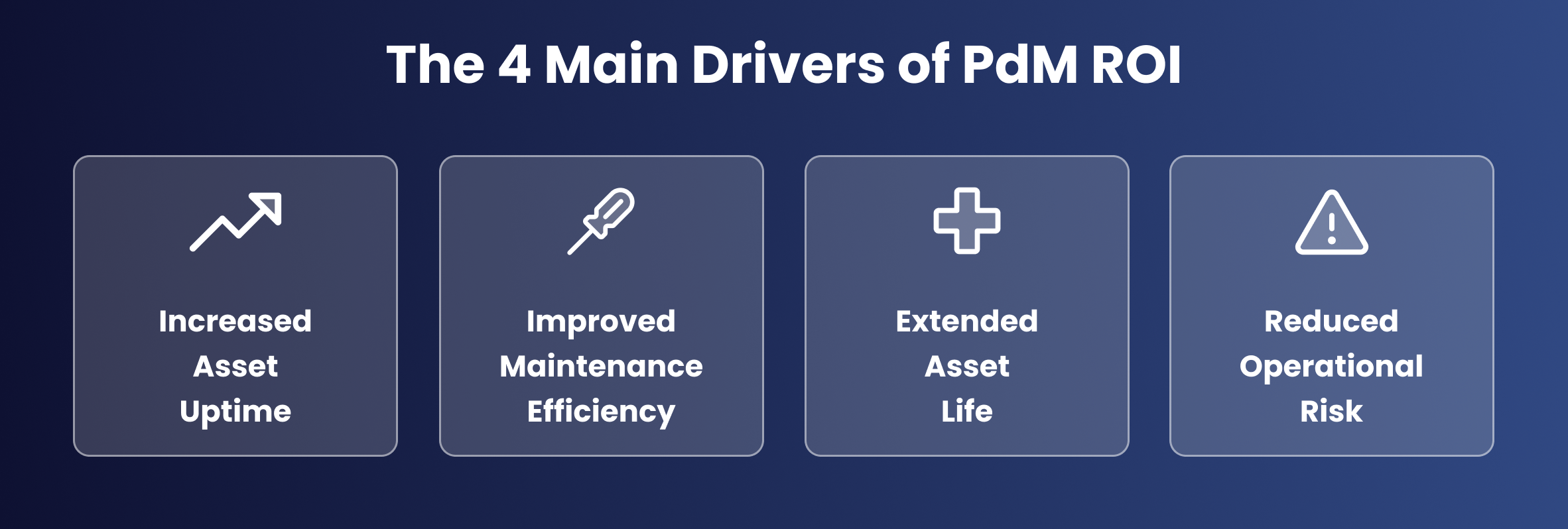
In Predictive Maintenance (PdM), return on investment is generated through 4 key operational levers that directly impact operational and financial performance:
- Increased Asset Uptime
- Improved Maintenance Efficiency
- Extended Asset Life
- Reduced Operational Risk
These 4 drivers correspond directly to the primary sources of financial gains (cash-in) generated by Predictive Maintenance.
Increased Asset Uptime
One of the primary financial drivers of ROI in Predictive Maintenance is increased asset uptime.
By detecting early signs of degradation, PdM reduces unplanned downtime, limits micro-stops, and stabilizes production. This leads to higher equipment availability, improved operational continuity, and more consistent output.
From a financial perspective, this results in reduced production losses, improved Overall Equipment Effectiveness (OEE), and better utilization of maintenance and production resources.
Because downtime is often the most significant cost driver in industrial environments, increased asset uptime typically represents one of the largest contributors to PdM ROI.
Improved Maintenance Efficiency
Another important contributor to Predictive Maintenance ROI comes from improved maintenance efficiency.
In traditional preventive maintenance programs, many inspections, replacements, and maintenance tasks are performed according to fixed schedules regardless of the actual condition of the asset. While this approach can reduce the risk of unexpected failures, it often results in unnecessary maintenance activity, avoidable asset shutdowns, and inefficient use of maintenance resources.
By continuously monitoring equipment condition, Predictive Maintenance enables maintenance teams to focus their efforts where intervention is genuinely required. This shift from time-based maintenance to real condition-based maintenance helps eliminate non-value-added activities and optimize maintenance planning.
In many industrial environments, the implementation of PdM can reduce planned maintenance activities by approximately 30%. From a financial perspective, this generates hard savings through reduced maintenance labor, fewer planned shutdowns, lower maintenance execution costs, and more efficient use of maintenance manpower. Unlike avoided-failure calculations, these savings often translate directly into released budget and workforce capacity, making them a meaningful and recurring contributor to overall PdM ROI.
Extended Asset Life
Predictive Maintenance enables maintenance activities to be planned based on actual equipment condition rather than fixed schedules or unexpected failures. This reduces unnecessary stress on components, limits progressive degradation, and helps prevent secondary damage.
From a financial perspective, this contributes to deferred capital expenditures (CapEx), reduced replacement frequency, and extended asset life. While these gains are often less visible in the short term than avoided downtime, they play a major role in sustaining PdM ROI over the long term.
Reduced Operational Risk
By identifying abnormal behavior early, PdM reduces the likelihood of catastrophic failures, safety incidents, compliance issues, and major production disruptions. These events are often low-frequency but high-impact, meaning that while they may occur rarely, their financial and operational consequences can be significant.
In many industrial environments, a substantial portion of PdM ROI comes from cost avoidance. By preventing major breakdowns, emergency interventions, secondary damage, or extended production interruptions, PdM helps avoid costs that would otherwise have a major operational and financial impact.
From a business perspective, this contributes to reduced operational risk, improved safety conditions, lower exposure to unplanned disruptions, and more stable production operations. Although these gains are often more difficult to quantify than direct maintenance savings, they frequently represent a substantial portion of the overall value generated by Predictive Maintenance.
What Determines PdM ROI
Predictive Maintenance (PdM) can deliver measurable value, but the level of ROI achieved depends on how effectively the program is designed, deployed, and operated. Rather than being fixed, ROI is determined by a combination of technical, operational, and organizational factors.
The most important key factors impacting return on investment include:
- Asset criticality: The primary driver of ROI is which assets are monitored. Monitoring a secondary asset will not generate the same value as monitoring equipment at the core of production. Focusing on high-impact machinery, where a single hour of downtime leads to significant losses, increases the likelihood that each monitoring effort delivers meaningful financial returns.
- Cost of downtime: ROI is strongly influenced by the financial impact of failures. The higher the cost of lost production, the greater the value of preventing downtime. In environments where downtime has limited consequences, the financial return of PdM will naturally be lower.
- Failure frequency and detectability: PdM is most effective when failure modes occur frequently enough and can be detected early through condition monitoring. Assets with rare or unpredictable failures may offer limited ROI potential, unless the impact of failure is particularly high.
- Data quality and reliability: High-quality, consistent, and well-contextualized data is essential for accurate detection. Poor data quality, incorrect sensor placement, or inconsistent measurements reduce the effectiveness of the program and limit its financial impact.
- Execution and integration into workflows: Detecting anomalies alone does not create value. ROI is realized when insights are translated into timely and effective maintenance actions, supported by clear processes and integration with maintenance management systems.
- Organizational maturity and adoption: PdM requires teams to trust data and adapt their decision-making processes. Without proper adoption and alignment between maintenance, production, and management, even well-designed programs may fail to become effective maintenance programs.
Understanding these factors is necessary, but not sufficient. Translating them into measurable financial results depends on how effectively asset selection, data quality, operational execution, and organizational alignment are structured and managed in practice.
How to Maximize Your PdM ROI
To maximize ROI, a Predictive Maintenance (PdM) program must go beyond simply deploying the right technology. It depends on how effectively the program is designed, implemented, and integrated into daily operations.
Several key levers have a direct impact on the financial performance of PdM:
- Focus on high-criticality assets first: ROI is driven by impact. Prioritize equipment where failures lead to significant production losses, safety risks, or high repair costs. Starting with high-impact assets allows you to demonstrate value quickly and build a scalable approach.
- Start with a focused scope and scale progressively: Rather than monitoring all assets at once, begin with predictive maintenance strategies focused on high-impact equipment. A pilot-first deployment helps validate assumptions, secure internal buy-in, and expand the program based on proven results. Alternatively, organizations can adopt an approach that combines monitoring technologies, data analysis capabilities, and reliability expertise from the start.
- Integrate PdM with your CMMS and maintenance workflows: Connecting PdM insights to your CMMS can enable more automated or streamlined work order creation, depending on the level of integration and system configuration. This reduces delays between detection and intervention, shortens response times, and ensures that identified issues are effectively addressed.
- Turn detection into execution: Predictive insights only generate value when they lead to timely and appropriate actions. Establish clear processes to ensure that detected anomalies result in planned maintenance interventions before failures occur.
- Move from time-based to condition-based maintenance: Replace unnecessary calendar-based interventions with data-driven decisions based on actual asset condition. This reduces unnecessary maintenance costs, avoids premature part replacement, and improves resource allocation.
- Ensure data quality and operational adoption: Reliable data and team engagement are critical. Maintenance and operations teams must trust and use PdM insights in their daily decisions for the program to deliver its full value.
- Continuously improve and refine the program: PdM performance improves over time. Regularly reviewing results, adjusting thresholds, and expanding monitoring scope allows you to boost ROI by capturing additional value and adapting to evolving operational conditions.
Maximizing PdM ROI is ultimately about closing the gap between detection and action, ensuring that every predictive insight translates into measurable operational and financial improvement. This means increasing cash-in (avoided costs, efficiency gains) while controlling cash-out (deployment and operational costs), to drive cost optimization and consistently generate sustainable financial value.
Ready to Turn Predictive Maintenance into Measurable ROI?
At I-care, we combine connected wireless sensors, advanced analytics, and reliability expertise to help translate predictive insights into measurable financial results. Our approach focuses on reducing unplanned downtime, improving productivity, optimizing maintenance costs, and maximizing ROI across your critical assets.