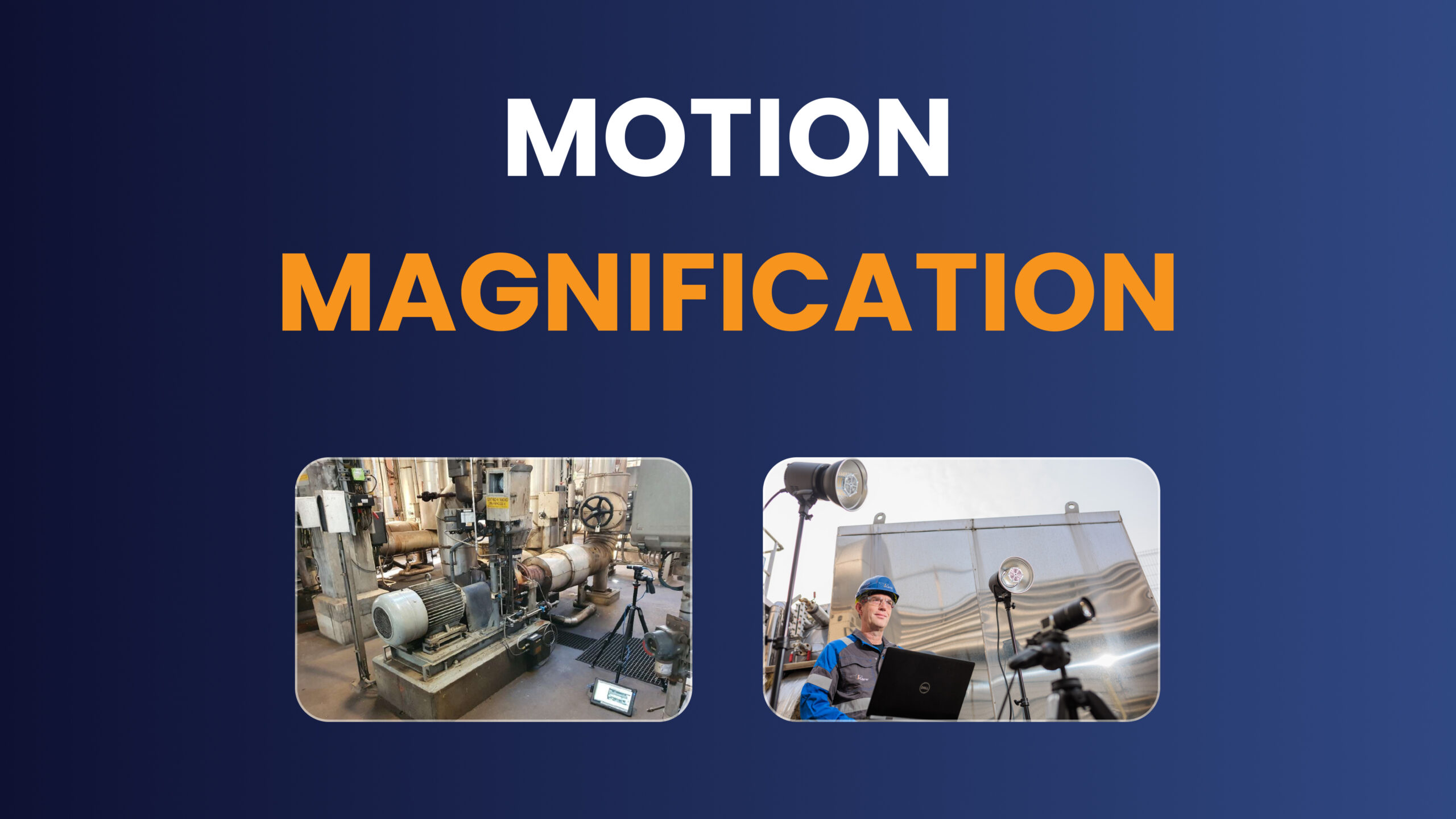
For decades, technicians chalked a white line on a spinning shaft and squinted under a strobe light to judge wobble by eye. Today, thanks to advanced technology and motion-magnification software, a quick video run can blow those micro-motions up 100x, revealing in seconds what used to take hours or days of inspection or guesswork.
This illustrates the evolution from traditional “tricks” to advanced maintenance practices, highlighting the importance of Predictive Maintenance (PdM), which relies on early detection of measurable condition indicators and fault signatures to identify emerging issues before they escalate into major failures.
Motion Magnification in Predictive Maintenance solutions is a visual Condition Monitoring technique that detects structural and dynamic anomalies by recording video of operating assets and structures and digitally amplifying their subpixel displacements. It is increasingly used across industries such as manufacturing, energy, and the oil and gas, as well as in critical infrastructure applications where non-contact diagnostics are essential for safety and uptime.
As a key element of Predictive Maintenance services, it enables the detection of subtle mechanical or structural defects, such as imbalance, misalignment, looseness, or resonance, long before they evolve into excessive vibration, fatigue damage, or costly unplanned downtime.
By transforming standard or high-speed video footage into clear, amplified visual evidence, Motion Magnification bridges the gap between qualitative observation and quantitative analysis, making hidden motion patterns literally visible to the naked eye.
This article serves as a complete guide to what Motion Magnification is, detailing how the technique works step by step, the hardware and software technology it uses, and how it integrates with a Predictive Maintenance platform. It also explores the types of anomalies it can detect, the assets to which it best applies, its advantages and limitations, and a real-world example showing how visualized motion can turn invisible anomalies into actionable insights for reliability and maintenance teams.
Table of Contents
What is Motion Magnification?
Motion Magnification technology is a powerful, non-contact visual Condition Monitoring technique used within Predictive Maintenance programs to detect subtle motion and structural or dynamic anomalies by recording standard or high-speed video of operating assets and digitally amplifying their subpixel displacements into measurable motion patterns.
This method is widely used in Predictive Maintenance, alongside other Condition Monitoring Techniques: Vibration Analysis, Infrared Thermography, Ultrasound Analysis, Oil Analysis, and Motor Circuit Analysis.
All machinery and structures naturally exhibit microscopic, visually imperceptible movements during operation. However, defects such as imbalance, misalignment, looseness, resonance, or cracking alter these micromotions, creating distinctive oscillation patterns once magnified.
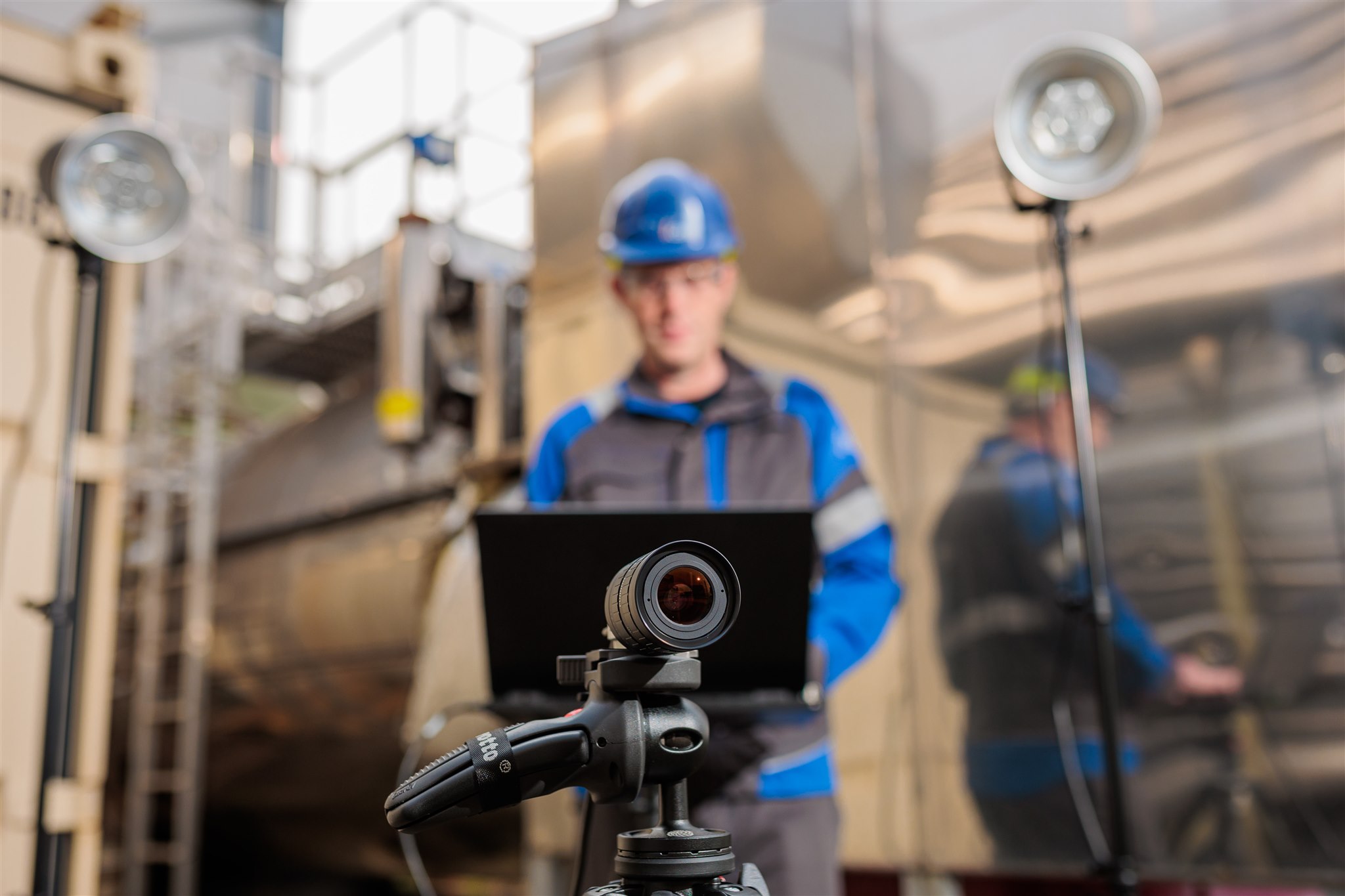
Within Predictive Maintenance, technicians perform motion magnification analysis using portable or fixed cameras and dedicated software to capture and analyze subtle motion in operating assets across the manufacturing industry, revealing emerging mechanical issues and defects long before they develop into excessive vibration, structural fatigue, or costly unplanned downtime.
What Does Motion Magnification Aim to Detect?
Motion Magnification detects a wide range of structural and dynamic anomalies that threaten equipment integrity and operational reliability. These are early symptoms of mechanical or structural degradation, allowing earlier intervention and more effective maintenance. The key benefit lies in identifying these problems through abnormal motion patterns revealed by video amplification, long before vibration levels or process parameters show measurable deviation.
Each fault mode generates a distinct visual signature that this technology amplifies and makes observable, translating subpixel motion into patterns that correspond to the physical behavior of the underlying defect.
Behind every motion signature lies a mechanical or structural phenomenon: imbalance produces circular or orbital shaft motion, misalignment introduces elliptical or figure-eight oscillations, looseness causes discontinuous or jumping movements at joints and mounts, and resonance amplifies motion at specific points when a component vibrates near its natural frequency. Cracks, fatigue zones, or weakened structures appear as localized flexing or fluttering under load, especially on smaller pieces or components where early deformation can indicate material fatigue.
Specifically, Motion Magnification can detect:
- Structural deflection: Amplified bending or displacement of beams, supports, or panels under load, indicating fatigue, loss of stiffness, or design imbalance.
- Resonance: Exaggerated cyclic motion at specific locations, revealing poor damping or operation near natural frequency.
- Machine looseness: Irregular or jumping movement at joints, fasteners, or baseplates, pointing to degraded anchoring or loose connections.
- Misalignment: Figure-eight or elliptical shaft motion during rotation, characteristic of angular or parallel shaft misalignment.
- Early-stage cracking: Localized flapping or opening and closing at high-stress points, indicating crack initiation or propagation in structural members.
Which Assets Are Typically Monitored with Motion Magnification?
In practice, Motion Magnification is applied to a wide range of mechanical and structural assets across industrial and manufacturing environments. Its effectiveness is particularly evident when monitoring equipment where small displacements, vibrations, or deformation patterns serve as early indicators of mechanical or structural faults.
Even minor variations in motion behavior, when amplified, can reveal developing issues that are invisible to the naked eye and difficult to detect with other condition monitoring technologies in practice, such as localized structural resonance or flexing in frames, brackets, or supports when vibration levels remain low or poorly transmitted to sensor locations. This allows maintenance teams to intervene before reliability, safety, or performance is compromised.
Typical assets monitored with Motion Magnification include:
- Rotating machinery (fans, motors, pumps, blowers)
- Gearboxes and drivetrain assemblies
- Structural elements (beams, frames, welds, or brackets)
- Piping systems and process lines
- Machine bases and foundations
- Blade and vane systems (impellers, turbines, axial fans)
- Robotic arms
- Precision actuators
How Does Motion Magnification Work?
Motion Magnification is a systematic process comprising the following five detailed steps:
- Deployment via portable or fixed-camera setups, depending on asset criticality, accessibility, and required monitoring frequency.
- Data collection of operating assets under normal load conditions, recorded using standard or high-speed cameras to capture natural motion behavior.
- Data transformation using advanced phase-based algorithms that amplify subpixel motion to make invisible displacements visible and measurable.
- Baseline comparison of current motion-magnified videos against reference recordings captured under known-good conditions to detect deviations or anomalies.
- Fault-signature mapping by interpreting amplified motion patterns to identify characteristic behaviors linked to specific mechanical or structural defects.
Step 1: Deployment Modes
Motion Magnification can be deployed in two primary modes: portable inspection and fixed-camera continuous monitoring, depending on the criticality of the asset, accessibility, and the required frequency of monitoring.
- Portable mode: In this mode, technicians use a standard or high-speed camera to record short video clips of suspect machinery or structures, such as couplings, fans, or pipe supports, during troubleshooting or routine inspection rounds. The footage is transferred to a laptop or tablet running motion-magnification software for processing and analysis. Portable mode is ideal for spot-checking assets during field inspections, as it requires minimal setup, uses tripod-mounted or digitally stabilized video capture, involves no production interruption, and enables non-invasive visual assessments.
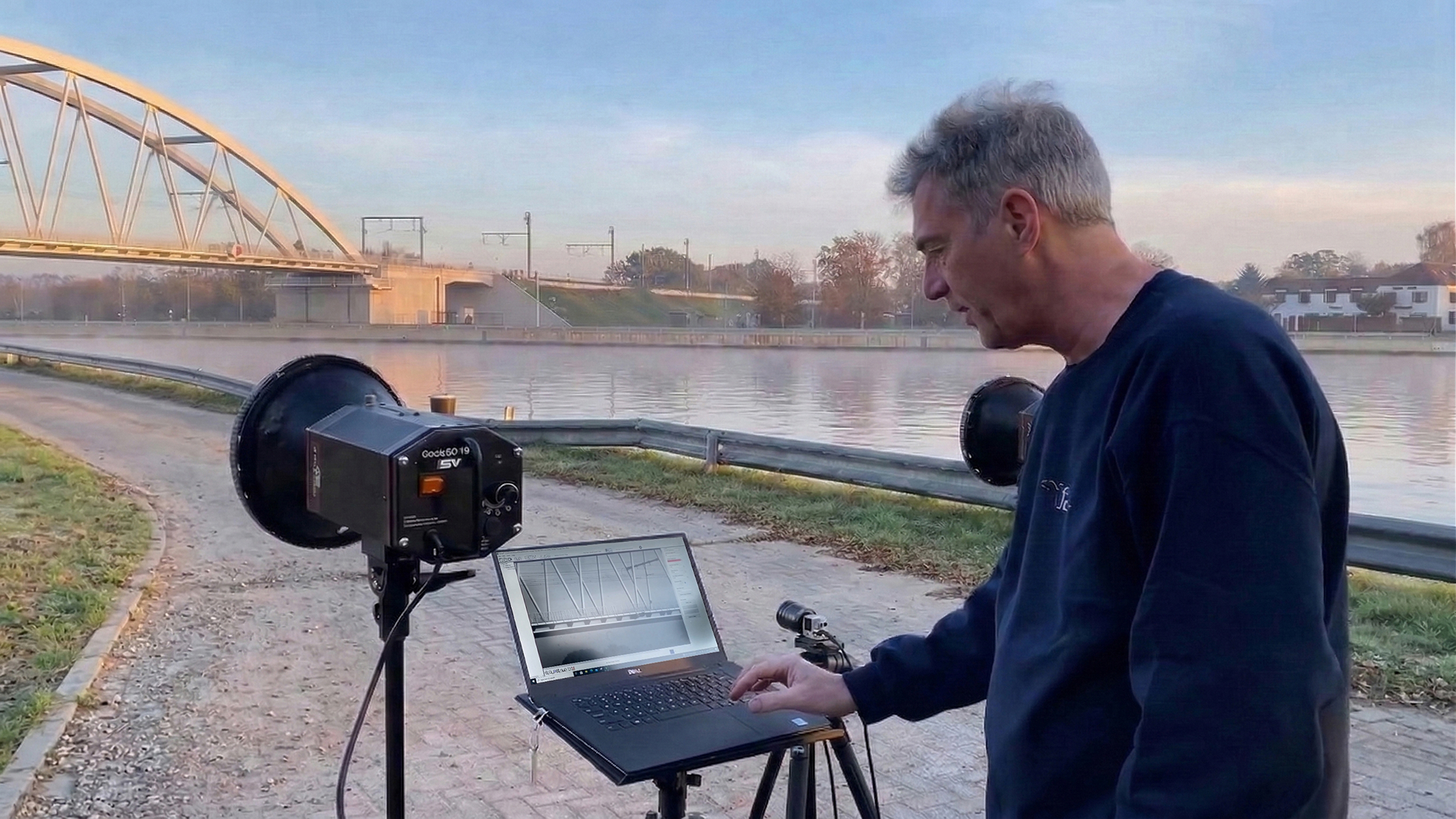
- Fixed-camera mode: In this mode, cameras are permanently installed to provide continuous visualization of motion behavior on critical assets or structures. Video streams are sent to an edge device or local server, where real-time motion magnification is applied. Fixed-camera systems rely on advanced imaging technology to provide continuous visualization of motion behavior on critical assets or structures. They are typically used on high-value or process-critical equipment, or in environments where constant feedback is essential, such as R&D test benches or precision manufacturing lines. By providing continuous visual monitoring, this mode ensures early detection of structural resonance or motion anomalies that could compromise stability or performance.
Step 2: Data Collection
Motion Magnification begins by recording a video of the asset operating under normal load conditions. The goal is to capture natural motion behavior without altering the system’s operation or performance.
Video is recorded using a standard or high-speed digital camera, depending on the frequency range of interest. Standard frame rates are sufficient for low-frequency or large-amplitude motions, while high-speed capture is preferred for higher-frequency vibrations or rapidly oscillating components.
The focus is placed on parts of the equipment most prone to subtle motion, such as couplings, fan blades, piping, or structural supports. The camera must have a clear, stable view of the area of interest, typically positioned perpendicular to the direction of expected motion to ensure accurate visual representation.
Lighting conditions, camera resolution, and frame rate are all adjusted to achieve clear, non-blurred footage suitable for analysis.
Step 3: Data Transformation
Once the video is recorded, the footage is transferred to the motion-magnification software for processing, where a dedicated algorithm and advanced digital technology amplify subtle movements that are usually invisible to the human eye.
In Predictive Maintenance applications, Motion Magnification relies on advanced video-processing algorithms that detect subtle changes in pixel content over time and amplify consistent motion patterns, making minute vibrations and displacements visible. By analyzing how each pixel changes over time, the software can isolate and amplify motion linked to mechanical or structural behavior without altering the overall appearance of the image.
These algorithms can increase subpixel motion by factors ranging from 10x to over 100x, converting imperceptible deflections into visible oscillations. The result is a new video sequence in which abnormal vibration motion, such as structural flexing, misalignment, or resonance, becomes clearly observable, allowing analysts to visually identify potential anomalies that would otherwise go undetected.
Some motion-magnification software also allows users to extract pixel-level displacement data from selected regions of interest. This enables detailed data analysis in the time and frequency domains, such as trend curves or FFT plots, to support quantitative validation of the observed motion. While this data does not replace accelerometer-based vibration measurements, it provides valuable insight into dominant motion frequencies or resonance phenomena.
Ready to Unlock Deeper Diagnostics and Make Every Maintenance Decision Count?
At I-care, our experts can go beyond visual amplification alone. The software we use within our I-magnify services delivers pixel-level displacement extracts, allowing precise time- and frequency-domain analysis that strengthens diagnostics and enhances the accuracy of every predictive maintenance decision.
Step 4: Baseline Comparison
Motion-magnified videos are ideally compared against reference recordings captured under known-good, or baseline, operating conditions. These baseline videos represent the normal dynamic behavior of an asset under stable load and speed, providing a visual benchmark for comparison over time.
However, baseline recordings are not always available, particularly during first-time inspections, troubleshooting activities, or on legacy assets. In such cases, analysts rely on expert interpretation of the amplified motion patterns themselves, evaluating symmetry, localization, and dynamic behavior to determine whether the observed motion deviates from expected mechanical or structural response.
When a baseline exists, meaningful comparison requires that both the current and reference recordings be captured under comparable conditions. This includes consistent lighting, frame rate, viewing angle, operating speed, and load. Even minor differences in setup can influence perceived motion amplitude or pattern, potentially leading to misinterpretation if not carefully controlled.
The objective of baseline comparison is to visually identify deviations in motion amplitude, symmetry, or distribution between current and historical recordings. Increases in oscillation intensity, newly localized movement, or changes in motion shape are strong indicators of emerging abnormal behavior.
Some motion-magnification software supports this process through overlay modes, side-by-side visualization, or displacement-trend extraction tools that help highlight differences between recordings and support more structured analysis.
Whether baseline-based or baseline-free, this evaluation remains primarily visual and qualitative, relying on expert judgment rather than automated thresholds. Its purpose is to determine whether abnormal or evolving motion behavior is present. Any motion patterns identified as suspicious at this stage should then be examined in greater detail during fault-signature mapping or validated using complementary condition monitoring techniques, such as vibration analysis.
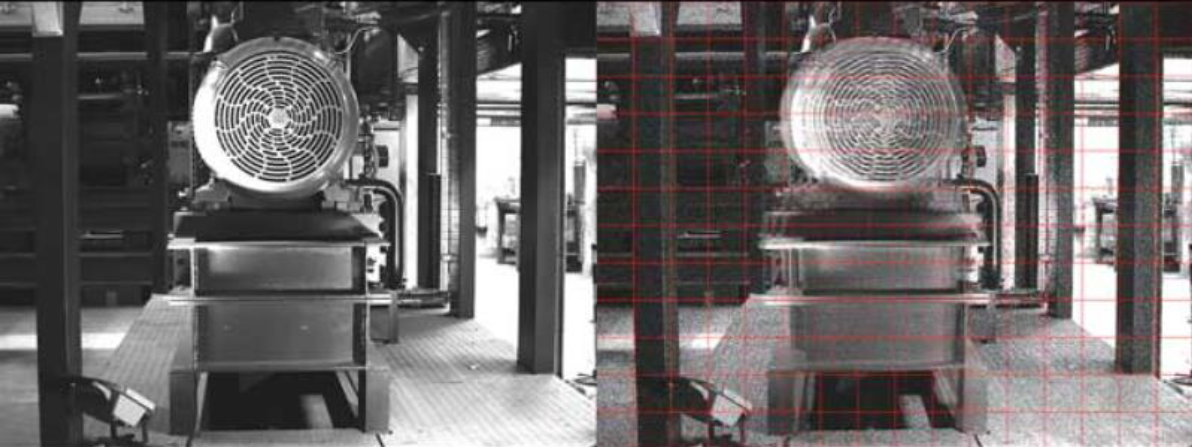
Step 5: Fault-Signature Mapping
Once the motion-magnified video is processed, analysts interpret specific movement patterns to identify potential mechanical or structural fault modes. Each defect type produces a distinct visual behavior, an amplified oscillation, distortion, or motion irregularity, that reflects the underlying physical cause of the anomaly.
In Motion Magnification, common fault signatures include:
- Circular or orbital shaft motion, which indicates an imbalance caused by uneven mass distribution.
- Figure-eight or elliptical oscillations, which reveal angular or parallel misalignment between coupled shafts.
- Sudden or irregular jumps at component interfaces, which suggest mechanical looseness in mounts, baseplates, or fasteners.
- Localized amplified motion at structural junctions, which highlights resonance occurring near a component’s natural frequency.
- Bending, flapping, or flexing of panels or beams, which expose cracks, fatigue zones, or weakened structural elements.
- Cyclic flutter or deflection in rotating blades or vanes, which signals aerodynamic instability or harmonic excitation.
Trained analysts or diagnostic software correlate these amplified motion patterns with known mechanical fault behaviors to visually diagnose the source of instability or degradation before it results in excessive vibration or structural damage that could ultimately cause unplanned downtime. This visual approach turns motion data into clear, intuitive evidence that complements traditional sensor-based diagnostics such as vibration data, confirming root causes of abnormal motion and guiding targeted interventions within the broader Predictive Maintenance workflow.
What Tools Are Used in Motion Magnification?
Motion Magnification relies on two categories of tools: hardware that captures subtle machine or structural motion through video acquisition, and software that amplifies, processes, and interprets those motions to support fault detection and diagnostics.
Hardware Tools
- High-Speed Cameras: Specialized cameras used to capture high-frequency motion phenomena that occur too rapidly for standard frame rates to record accurately. Typically operating at several hundred or thousands of frames per second, they are used during advanced diagnostic investigations on fast-moving or rotating assets such as fans, couplings, or impellers to visualize vibration, resonance, imbalance, or structural looseness.These cameras are typically used during targeted diagnostic studies or troubleshooting campaigns, where accurate visualization of high-frequency phenomena is essential for confirming resonance, imbalance, or structural looseness.
- Standard Digital Cameras: Conventional video cameras used to capture low-frequency or large-amplitude motion during routine inspections. Lightweight, portable, and cost-effective, they are commonly used in Motion Magnification applications to visualize structural deflection, looseness, or low-speed mechanical movement once amplification is applied.
Software Tools
- Motion Magnification Analysis Software: Advanced video-processing platforms used to amplify subtle motion captured on video and convert it into actionable diagnostic information. These tools allow users to isolate specific frequency ranges, adjust amplification levels, visualize displacement behavior, and extract vibration-related data such as waveforms, displacement trends, and FFT spectra to support fault identification and resonance analysis.
How Does Motion Magnification Integrate with a Predictive Maintenance Platform?
Motion Magnification data, typically generated from video files processed offline or streamed from fixed-camera setups, feeds into the Predictive Maintenance platform (e.g., I-see software) to enhance predictive maintenance through visual motion insights and cross-technique correlation.
Once ingested, the platform stores and organizes the processed motion data along with relevant metadata such as asset tag, timestamp, and load condition. It then:
- Archives annotated video clips and extracted displacement plots for historical tracking and comparison.
- Provides a workspace where analysts can visually identify and manually tag motion signatures with likely fault types (e.g., misalignment, looseness, resonance).
- Relies on expert interpretation, as issues observed in the videos are encoded manually rather than triggered by automatic thresholds or deviation rules.
- Suggests maintenance actions or work orders in the CMMS or ERP system for timely and prioritized response.
What Are the Advantages of Motion Magnification?
By visually amplifying movements that are otherwise imperceptible to the human eye, Motion Magnification stands apart with four key advantages that make it highly valuable across the industry for reliability and maintenance applications.
The first one is its ability to visually reveal otherwise imperceptible movements, making it a powerful tool for observing mechanical or structural behavior. This clear, visual feedback helps maintenance and reliability teams identify issues such as imbalance, misalignment, looseness, or resonance long before they escalate into vibration problems or structural damage.
Another key advantage is that Motion Magnification simultaneously captures interactions among multiple components within a single visual field. Instead of analyzing one point at a time, as with conventional sensors, the technique provides a full-field perspective, showing how components move relative to one another and revealing complex dynamic relationships across assemblies.
A third advantage lies in its highly communicative visual output. Because results are presented as intuitive videos, amplified motion patterns are immediately understandable, even to non-technical stakeholders. This makes it easier to justify maintenance actions, share findings with management, and align decisions across engineering, production, and reliability teams.
Finally, Motion Magnification is flexible in deployment. It can be used with standard cameras for quick demonstrations, while optimal diagnostic results are achieved with high-quality, non-compressed video from dedicated cameras or fixed monitoring installations. This versatility makes it suitable for both rapid troubleshooting and continuous monitoring in demanding industrial environments.
What Hidden Movements Are Costing You Performance, and How Soon Do You Want to Find Them?
Subtle structural deflection, imbalance, or misalignment often remain invisible until they lead to costly vibration or fatigue issues.
With I-care’s Motion Magnification services (I-magnify), these early signs are captured, amplified, and analyzed with precision, helping you prevent unexpected breakdowns, improve efficiency, optimize performance, and strengthen reliability.
Turn invisible motion into actionable insights.
What Are the Limitations of Motion Magnification?
While Motion Magnification is a powerful visualization and diagnostic technique, it has certain limitations that affect accuracy and practical applicability:
- Requires clear line of sight: The camera must have an unobstructed view of the area of interest. Obstructions, poor lighting, or indirect angles can reduce motion visibility and compromise analysis accuracy.
- Sensitive to camera stability: Even minor camera movement or external vibration can introduce false motion into the footage. In industrial environments where the camera is mounted on vibrating structures or platforms, stabilization techniques such as rigid mounting, vibration isolation, or digital stabilization may be required to reduce camera-induced artifacts. However, insufficient stabilization can still compromise result accuracy.
- Limited by video quality and frame rate: Low-resolution or compressed video may obscure small displacements or high-frequency motion, reducing diagnostic precision.
- At I-care, this limitation is mitigated by the last update of the software we use, which removes the 78 Hz maximum frame-rate constraint and enables analysis at higher frequencies. Discover our Motion Magnification services.
- Provides qualitative rather than quantitative data: Motion Magnification is primarily a visualization technique. It identifies where and how abnormal motion occurs, but must be complemented by quantitative tools, such as vibration, ultrasound, or electrical analysis, to confirm severity and root cause.
- Still perceived as an emerging technology: In many industrial contexts, Motion Magnification is still considered a relatively new or “experimental” approach, leading to skepticism about its proven effectiveness. However, field deployments have demonstrated strong reliability when this technology is used alongside established condition monitoring techniques.
Real-World Example of Usage
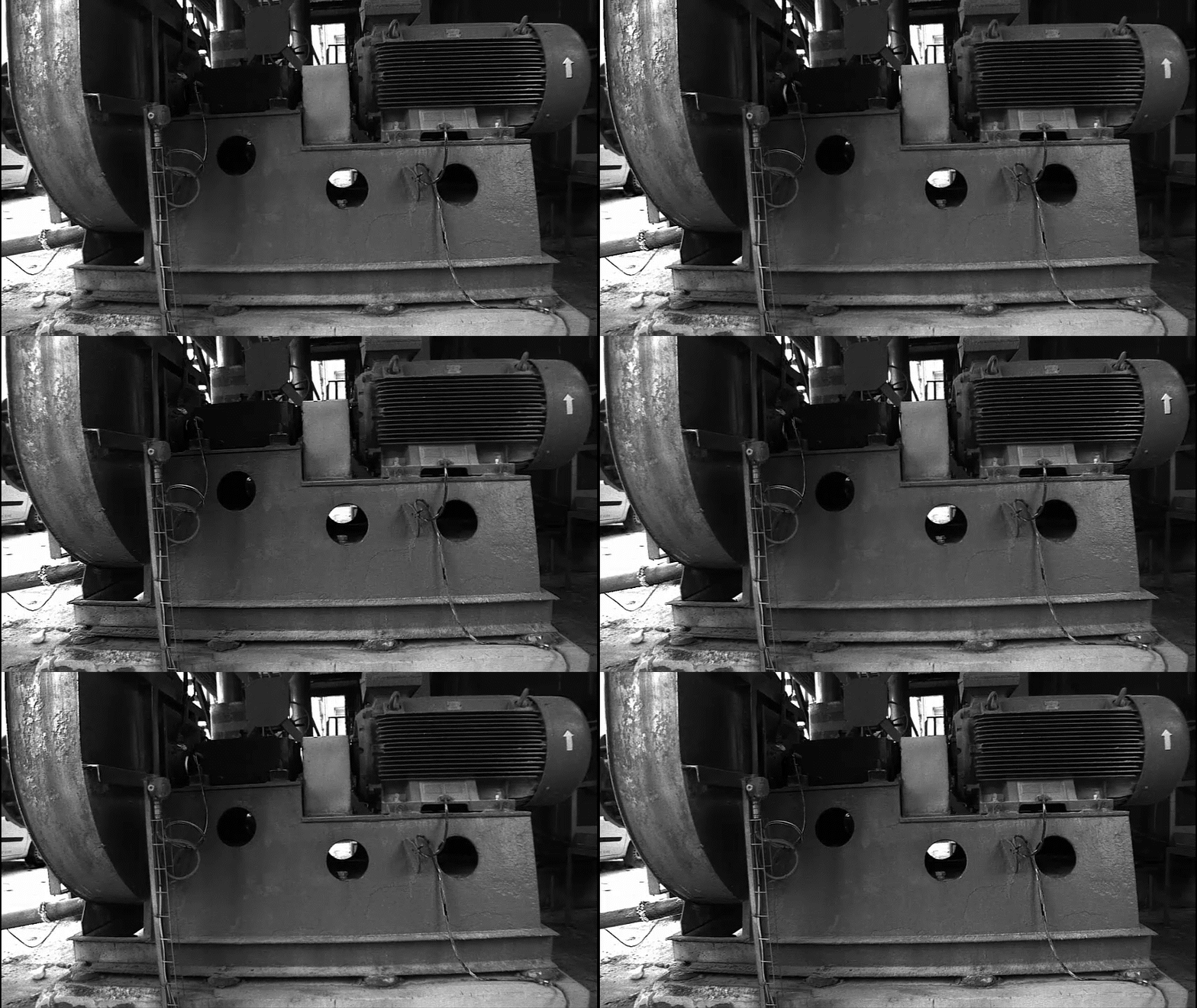
In a pulp and paper mill, Motion Magnification was used to investigate abnormal vibrations in a high-speed fan assembly connected to a drying hood. Although standard vibration analysis showed only marginal deviations, maintenance teams suspected mechanical looseness or resonance in the support structure.
A high-speed camera was set up during operation to record the fan, motor, and supporting frame. The footage was processed in the Motion Magnification software, revealing subtle figure-eight oscillations at the coupling and lateral flexing of the motor base, clear visual signatures of combined misalignment and soft foot conditions. These motion patterns were invisible to the naked eye and went undetected by sensors or point-based vibration data alone.
Based on this visual evidence, the maintenance team realigned the motor and shimmed the base during a scheduled shutdown. The intervention restored mechanical stability, reduced vibration levels, and extended bearing life, helping prevent unexpected breakdowns, improve efficiency, and enhance predictive maintenance within the plant’s continuous production environment.

Necessary Skills and Training
Motion Magnification requires a skill set that spans from basic video acquisition to advanced motion interpretation, depending on the practitioner’s role and depth of involvement.
Skill Needed
Motion Magnification requires a basic to intermediate level of expertise, depending on whether the focus is on routine visual inspections or advanced diagnostic analysis.
For basic use of the technique, technicians need a solid understanding of camera positioning, lighting control, frame rate selection, and video stabilization to ensure high-quality footage. They must also be able to use motion magnification software to apply amplification filters, isolate frequency bands, and clearly visualize motion behavior. At this stage, introductory training is typically sufficient for reliable field data collection and visual interpretation of amplified motion.
In-depth analysis and diagnosis demand a deeper understanding of signal amplification theory, frequency filtering, and mechanical behavior interpretation, such as distinguishing resonance from imbalance or looseness. Analysts must be able to select appropriate regions of interest, tune amplification parameters, and interpret motion artifacts with confidence. Familiarity with extracted time- and frequency-domain plots further enhances diagnostic precision and supports more accurate fault identification.
Training
Is your team looking to leverage Motion Magnification technology more effectively within your Predictive Maintenance strategy?
At I-care, we provide tailored Motion Magnification training programs delivered directly to our customers. These sessions are dedicated to client teams, not open public classes, ensuring the content is fully aligned with each site’s assets, challenges, and reliability objectives.
These on-site sessions are ideal for reliability teams working in complex production facilities, where visual diagnostics can accelerate troubleshooting and strengthen Predictive Maintenance programs by complementing other condition monitoring techniques.