The Internet of Things (IoT) for Predictive Maintenance (PdM) is expanding rapidly, and with it, hundreds of new options for wireless vibration monitoring. As vendors rush to enter this growing market, the real question becomes: which solutions are built on deep machinery expertise, and which are simply adding vibration sensors to an IoT platform?
Predictive maintenance holds huge promise: less downtime, longer asset life, reduced maintenance costs, and fewer nasty surprises. But realizing that value is built upon one thing, consistent, accurate data. Unfortunately, most “solutions” are only looking at a partial picture of machine health. They may even perform well during a pilot, but struggle to detect the most damaging defects when it really matters. If you’ve had a disappointing experience with wireless vibration, it didn’t need to happen. Read on to find out why.
Experience Matters When Every Signal Counts
At I-care, one of the world’s largest independent vibration service companies, our teams have analyzed billions of machine hours over the past 20+ years, and today we process data from more than half a million machines every day. Decades of real-world machinery expertise have shaped every design decision. Based on that deep knowledge, our patented I-DNA signal processing technology is designed to capture the signals that matter most.
Many new market entrants may be experts in wireless technology, but lack a background in machinery analysis. Their systems may identify the “easy ones” like misalignment and unbalance, but only detect the “production killers” (high-consequence failures such as rolling element bearing faults or gear defects) in the later stage of the failure progression. These are the failures that actually shut a plant down.
Why Standard Vibration Alone Isn’t Enough
Traditional vibration analysis programs often rely heavily on standard vibration severity metrics as defined in ISO guidelines, which primarily track machine-level behavior such as casing vibration levels. That information is valuable, but it doesn’t reliably detect the failures that most often shut down the plant.
Commonly in industry, rolling element bearing and gear failures are the most common causes of unplanned downtime.
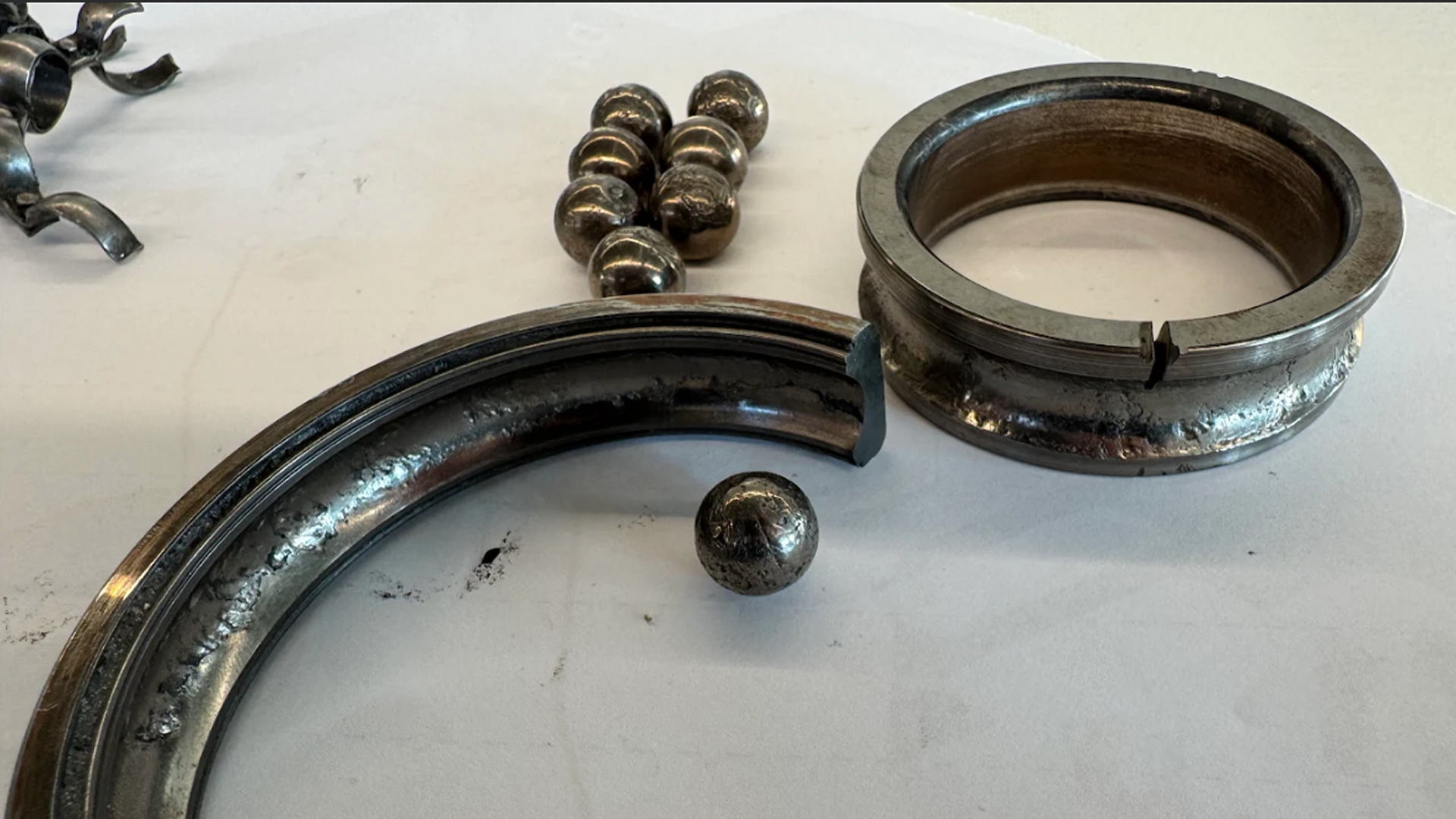
These defects typically begin as high-frequency impacting events, long before they appear in standard vibration metrics. In reliability engineering, this progression is visualized using the P–F curve, which shows how early-stage defects evolve toward a functional failure over time.
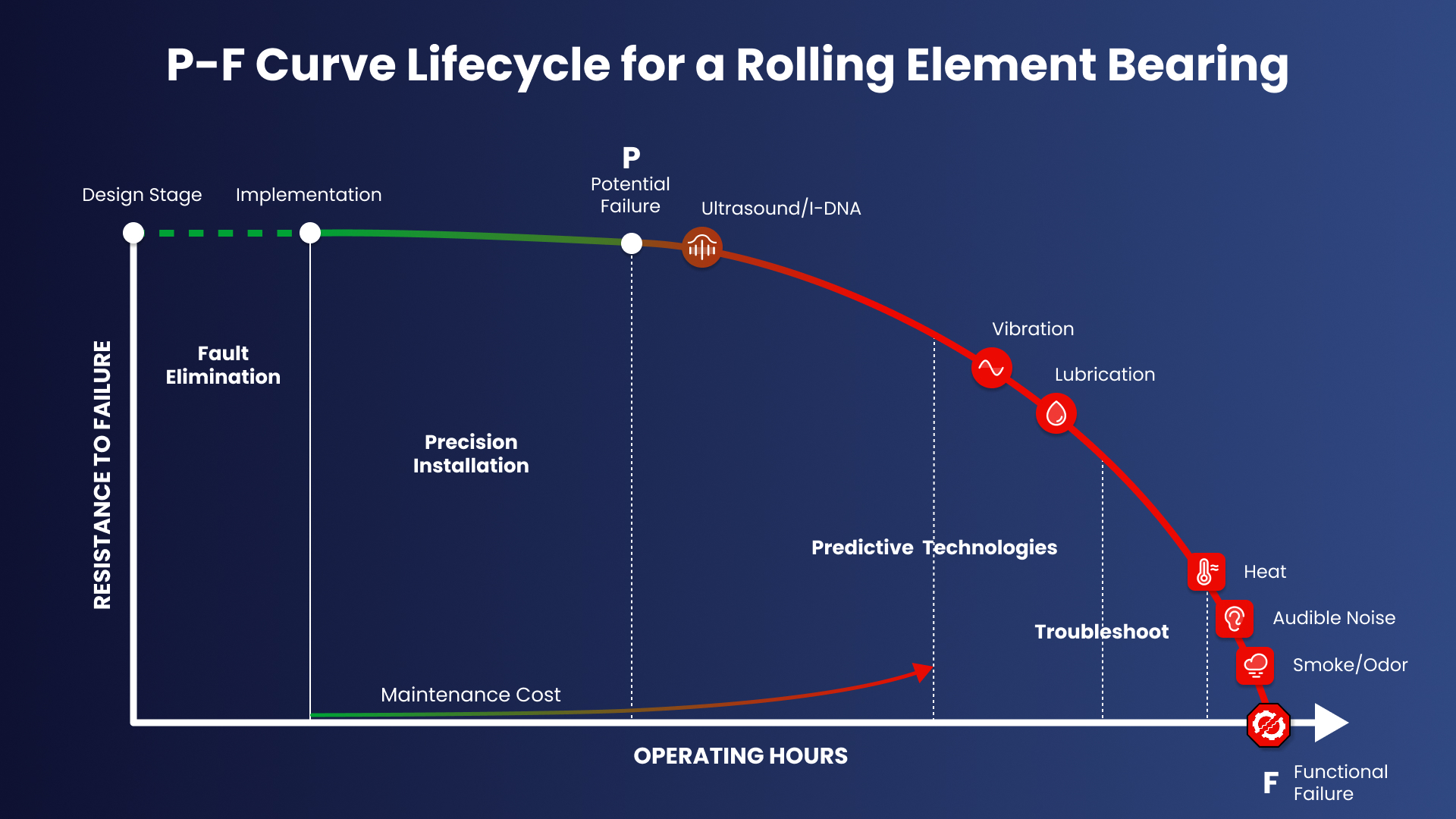
In the P–F Curve, the earlier a defect is detected after the Potential Failure (P) point, the more time the maintenance team has to intervene before Functional Failure (F) occurs.
Systems that rely only on conventional vibration measurements often identify these issues closer to the F point, when response options are limited. I-care sensors are designed with this reality in mind, capturing not only standard vibration, but the impacting signals that indicate high-consequence failures at their earliest stages.
Designed for Complete and Accurate Data
Every aspect of vibration sensing, from how signals are captured to how they’re processed, influences the reliability of your insights.
I-care’s sensors are engineered for comprehensive and high-quality data capture, including access to high-frequency impacting and the raw vibration signals. Deep machine expertise coupled with intelligent design ensures you’re monitoring the right signals the right way, delivering dependable results for the long term.
Behind the Black Box: Everything built on Good Data
Many wireless IoT vendors focus primarily on connectivity and sensor hardware, relying on third-party signal processing frameworks for vibration analysis. In some implementations, this architecture can limit a device’s ability to detect the impact patterns associated with the “production killers”. These key signals may be completely missing from the processed vibration data. Or, when a developing bearing defect is detected, it may not appear until just before failure, leaving precious little time to respond.
To capture these signals reliably and at the earliest possible moment, I-care developed and patented its I-DNA technology. This measurement is critically important for detecting early-stage defects in machines equipped with rolling element bearings. I-DNA filters out the high-amplitude signals from the shaft, coupling, and machine casing and listens in the high frequency range for impacting. It can detect the onset of a bearing defect at its earliest stages.
To accurately and dependably detect these impacts, advanced signal processing is key. That’s where I-care’s sensors are designed differently. By preserving access to the raw vibration signal, they allow analysts to examine both standard vibration behavior and high-frequency impacting using I-care’s patented I-DNA measurements. This transparency makes it possible to confirm diagnoses, assess defect progression, and distinguish between real mechanical issues and false positives.
The same sensing element also supports a third measurement: lubrication effectiveness. Since lubrication breakdown is one of the most common root causes of bearing and gear failures, this insight helps teams move beyond fault detection toward understanding why failures develop in the first place.
Together, these measurements provide a foundation for professional analysis rather than automated guesswork, allowing analysts to examine raw signals, confirm diagnoses, and track defect progression over time. Reliability teams gain visibility into what is happening inside the machine, its severity, and how quickly conditions are changing, enabling earlier and more confident maintenance decisions.
The Impact of Measuring Severity
Where Traditional Measurements Fall Short
Most “solutions” rely heavily on the FFT vibration spectrum for analysis. After all, this is what we’re taught in a vibration class. While the spectrum is very useful in catching lower frequency issues (e.g., unbalance, misalignment, looseness), it falls short when confronted with impacts caused by the “production killers” (e.g., bearing defects, gear damage, pump cavitation, or lubrication failure). In some cases, these defects may not become clearly visible in the spectrum until later in the failure progression.
However, that information is present in the raw vibration waveform. It simply requires the appropriate signal processing to extract it. The challenge is that many wireless vibration systems rely on third-party signal processing frameworks. In some cases, this architecture limits access to the raw vibration waveform required for advanced diagnostic analysis. Meanwhile, I-care’s I-DNA technology not only alerts you to the presence of these killers but also provides information about the severity of the defect. Without this extra level of information, you may even know that a defect is present, but be unsure about when it’s appropriate or perhaps even unavoidable to shut down for maintenance.
The “secret sauce” in I-care’s I-DNA technology is the radically high sampling rate. To understand this, think of using a strobe light to watch someone move around the room. If the strobe is flashing once per minute, then you see where the person is every 60 seconds. But what happened in the dark? You assume it was a constant motion between the last two known positions. But if they were fast enough, they could have left the room and run back in. And the naked truth is that you just don’t know. So if you flash the strobe faster and faster, each time you have more and more confidence that your assumption is correct. Now imagine you flash the strobe so fast that the room appears to be continuously illuminated. Now there are no assumptions, no guessing. That is the principle applied to ensure the I-DNA technology sees everything happening on your machine. Furthermore, because the Wi-care accurately captures the entire machine motion, it not only knows what is happening, but it can also quantify the severity of the defect.
Why Industrial Leaders Trust I-care
With I-DNA and lubrication insights feeding into the I-care Cloud platform, maintenance teams gain access to advanced diagnostic tools and a unified view of asset condition. I-DNA’s advanced signal processing enables earlier warnings, more reliable defect detection, and clearer severity assessment, helping teams identify mechanical issues long before functional failure occurs.
Within I-care’s platform, Vibration data can be combined with oil analysis, thermography, ultrasound, and motor testing to build a complete picture of machine health across both balance-of-plant assets and complex machine trains. Through open APIs, this information can be seamlessly integrated with your CMMS system for maintenance planning or your plant historian to correlate asset health with the process condition.
Beyond technology itself, I-care specialists bring deep mechanical and reliability expertise, bridging engineering knowledge with advanced analytics to design monitoring strategies that fit your facility’s critical assets and potential failure modes. Detecting faults earlier by moving up the failure curve, your organization gains time to plan interventions, avoid unplanned outages, and improve overall equipment reliability.
Book a meeting with an I-care expert to learn how smarter vibration sensing and deeper machinery insight can improve uptime across your operations.