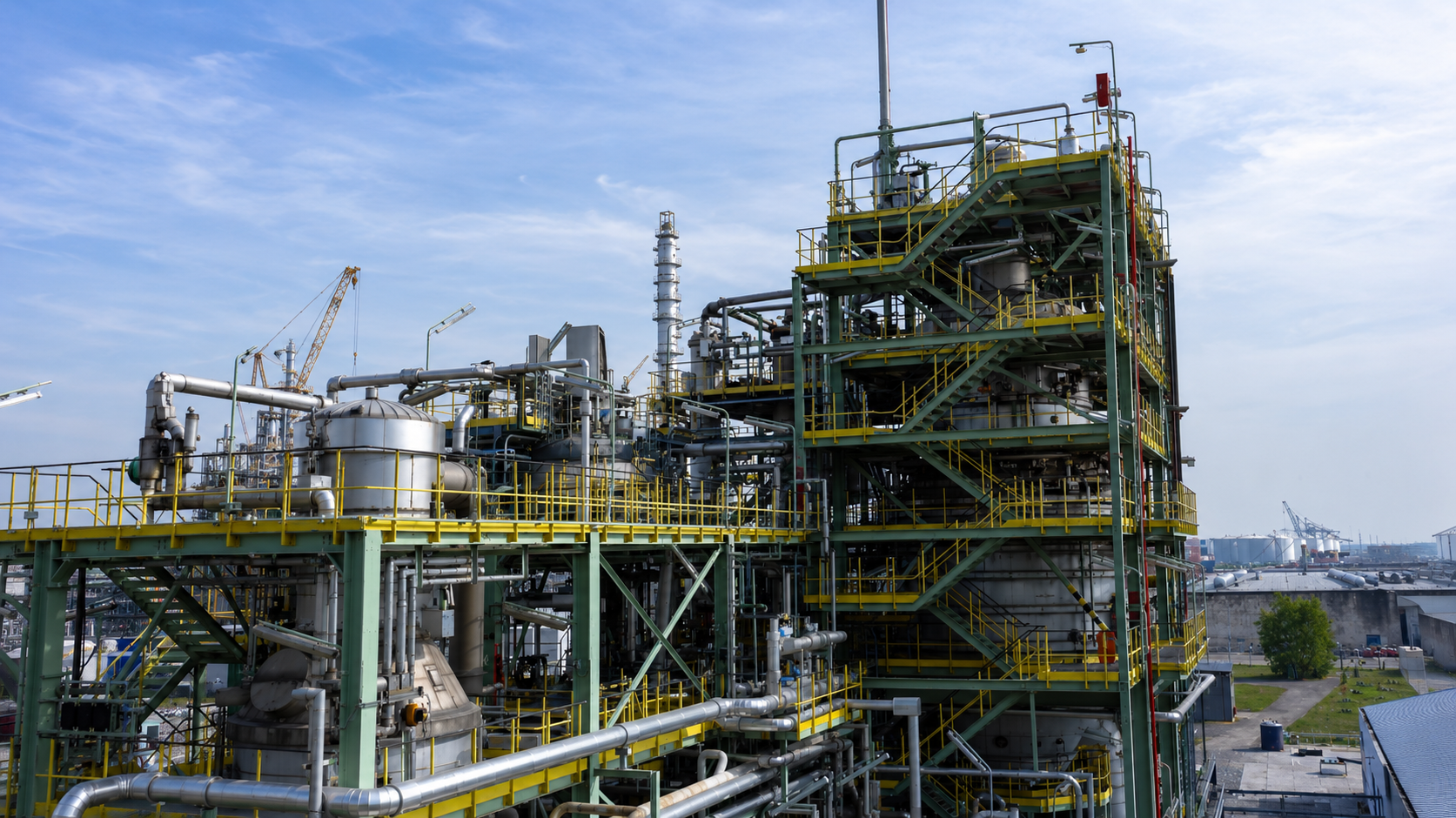
The Site Never Really Sleeps
The plant is already running when I arrive.
Pumps are moving chemicals through kilometers of pipework. Compressors are running at high speed. Steam rises off equipment that has been operating through the night. Even at a distance, you can hear the constant mechanical noise. In certain areas, heat radiates from process equipment or steam lines.
The site produces a hazardous base chemical that feeds more than a dozen downstream units. If a critical part of that process stops, the disruption can spread quickly across connected operations. In some areas, even a single equipment failure can interrupt production across multiple connected units. In others, the bigger concern is the potential consequences of a loss of containment.
I don’t repair machines. My job is to spot the moment they start drifting away from normal, before anyone else notices.
Nothing Starts Without Clearance
Before I take a single measurement, I go through the same routine.
PPE is mandatory. I carry a lower explosion limit detector to monitor for flammable gas and an oxygen meter in case levels drop. Some areas require operator clearance before entry. Depending on process conditions, I may have to wait before accessing certain pumps or compressors.
That’s part of the job. Work happens within the constraints of the plant, not the other way around. Once everything is cleared, I start my planned measurement route.
The First Readings of the Day
I follow a predefined route that covers roughly 70 to 90 critical assets across the site. The goal is consistency. I measure the same assets, in the same order, at the same locations each cycle, so vibration trends are reliable.
Getting to each measurement point isn’t always straightforward. Some assets are elevated, requiring access through multiple levels of steel structures. Others require coordination with operations or access clearance, depending on process conditions.
Monitoring frequency depends on asset criticality. On this site, most equipment is monitored monthly, while slower or less critical assets are checked quarterly.
Each pump or rotating asset is measured at the drive end (DE) and non-drive end (NDE) bearings, across three axes: horizontal, vertical, and axial. That gives a structured view of how vibration is behaving through the machine.
I use a handheld vibration data collector with a single-axis sensor, applying it repeatedly across each measurement point. On a typical day, I’ll collect several hundred individual readings.
Alongside vibration, I record temperature. For example, on some assets, a bearing that normally runs around 50°C might creep up toward 90°C or higher as friction increases. When temperature rises alongside changes in vibration, it provides an extra indication of developing mechanical degradation, which is down in a further stadium.
Patterns Start to Emerge
By mid-morning, I’m no longer just collecting data. I’m starting to analyse the data.
In this environment, I don’t rely on absolute thresholds alone. If the same pattern appears across multiple measurements of the motor or pump, for example, and continues to evolve over time, that’s when it becomes actionable.
Rotational speed, or 1x as we say, is the baseline. If I see increasing amplitude at 1x combined with harmonics, that can point to misalignment or mechanical looseness. If higher-frequency energy starts to appear, that can indicate early-stage bearing degradation.
Most of the changes are subtle. A small amplitude increase, a small shift in frequency content. That’s exactly what matters. Because once those patterns become obvious, it’s usually too late to plan.
The Plant Sets the Pace
Not every measurement is straightforward. Some assets are in restricted zones where I need operator coordination. Others require gas checks before entry. If process conditions aren’t stable, I move on and come back later.
Some measurements take only a few minutes, but accessing them can take significantly longer depending on plant conditions.
And then there’s production. If a unit is being adjusted or operators need priority access, I step aside. The plant runs first. Monitoring fits around it.
One Asset Stands Out
By early afternoon, I start reviewing trends and spectra more closely. One pump I’ve been tracking for several months stands out. It’s a horizontal centrifugal pump transferring hazardous fluid between two process units. If it fails, it affects multiple downstream processes and introduces environmental risk.
The trend has been building slowly. Over the past three measurement cycles, I’ve seen a progressive increase in vibration amplitude at 1x rotational frequency, along with developing harmonics. The pattern is consistent with mechanical looseness in the pump assembly, although such signatures can have multiple causes and typically require confirmation during inspection. It’s not yet at a critical level, but the trend is moving in that direction.
At this stage, the question isn’t whether there is an issue, but how fast it is evolving and when to intervene. That decision depends on factors like production dependency, safety risk, and the ability to plan the work without disrupting operations. Acting too early can disrupt production unnecessarily, while acting too late increases the risk of failure and production loss.
When You Can’t Stop the Machine
This is where reality comes in. Situations like this don’t always lead to immediate intervention. In a similar case I tracked in the past, stopping the pump immediately would have required an unplanned shutdown. That would have impacted several connected units and disrupted production across part of the site.
In that case, the decision was made to continue operating while monitoring closely. Over the following six to nine months, the condition continued to be monitored. Vibration levels continued to rise. What started as a small deviation became a clear and repeatable pattern across all measurement points.
At one stage, amplitude levels increased by more than 30-40% compared to baseline, with the trend becoming consistent and repeatable across measurement points, indicating that the mechanical condition was no longer stable. The risk shifted from performance degradation to potential failure. Because that history was available, the decision was not reactive. The pump was taken offline during a planned shutdown window before any loss of containment occurred.
Inspection confirmed degradation within the assembly. Components were repaired before they failed in operation. Without that timeline, the same issue could have resulted in an unplanned stop or, in a worst-case scenario, a loss of containment involving hazardous material.
That kind of situation is not unusual in this environment. The pump I’m looking at today may follow a similar path. What matters is tracking how quickly that change happens and deciding when to act.
From Data to Action
At the end of the day, I compile my findings. Using I-care’s reporting tools, I document what I’ve measured, what has changed, and what needs attention.
When an issue reaches a defined threshold, it is escalated with a recommended action and timeframe, either within I-care’s reporting tools or integrated into the site’s maintenance system, depending on how workflows are set up.
From there, the maintenance team takes over to plan and execute the intervention.
On the next measurement cycle, I’ll check again. I’ll look at whether the trend has stabilized, whether the issue has been addressed, or whether it is still progressing. Sometimes, vibration data provides the clearest confirmation that something has changed, particularly in situations where maintenance actions are not fully captured in records.
Nothing Happened, and That’s the Point
By the time I leave the site, nothing has failed. No alarms. No emergency calls.
But across 70 or more assets, the condition is clearer than it was this morning. Small changes have been identified. One developing issue has been tracked further. Decisions have been made with more information than yesterday. Most of the time, no one sees this work. And that’s the point.
Want to Detect Mechanical Risks Before They Impact Safety or Production?
Discover how I-care supports chemical manufacturers with predictive maintenance programs adapted to the constraints of continuous industrial operations, helping teams detect early-stage faults, increase the lifespan of equipment by reacting with minor actions like lubricating, plan interventions around production constraints, and reduce the risk of unplanned downtime or safety incidents.